
Performance-Based Questions Explained: Why Most A+ Candidates Lose Here?!
They are worth more than multiple-choice, they eat your clock, and they punish memorisation. Here is how PBQs actually work and how to stop bleeding marks on them.

In this article
Ask anyone who narrowly failed A+ what beat them, and most will say the same thing: they ran out of time, or they froze on the simulations. Both problems trace back to the same feature of the exam — the performance-based question.
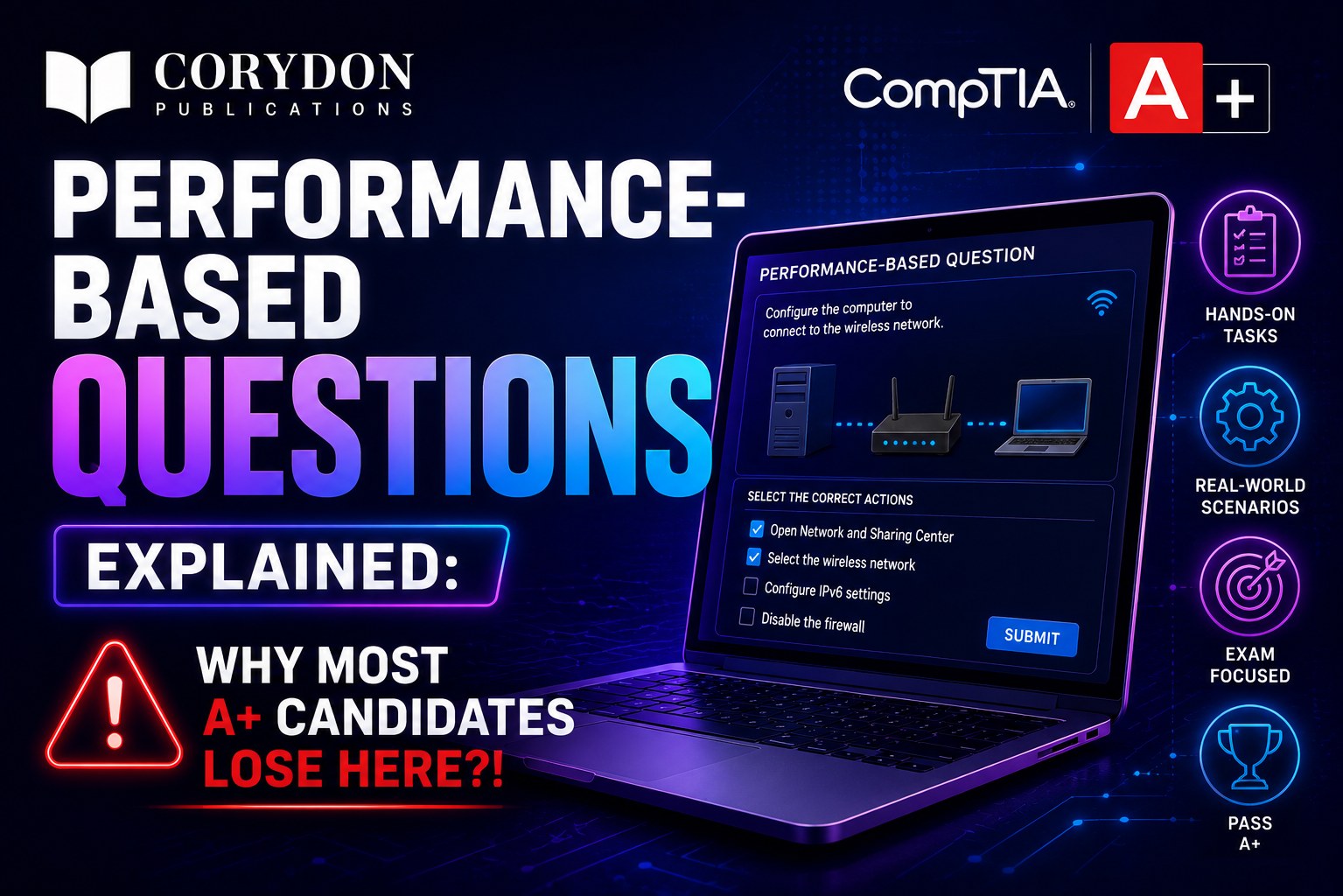
A PBQ is not a multiple-choice question with extra steps. It is a small interactive task: configure a firewall rule, drag the right RAM into the right slot, sort log entries, type a command that fixes a stated fault. There are usually a handful at the very start of the exam, and they are weighted more heavily than the multiple-choice questions that follow.
What a PBQ actually is
The exam presents a scenario — a few sentences of context — and an interface. Your job is to make the interface reflect the correct answer. That might mean assigning IP settings, matching a connector to a port, choosing security settings for a scenario, or issuing commands at a simulated prompt.
The crucial thing is that PBQs test whether you can do the thing, not whether you can recognise the right words. You cannot bluff them. This is exactly why CompTIA uses them, and exactly why candidates who studied by re-reading notes struggle.
The PBQs are usually the first thing you see. Panicked candidates sink twenty minutes into the opening simulations, then face 85 multiple-choice questions with an hour gone. The order of the exam is designed to test your composure as much as your knowledge.
Why they cost people the pass
Three reasons, in order of how often they sink people.
Notice that only a small slice is a real knowledge gap. The rest is exam craft: pacing, understanding the difference between reciting and doing, and reading carefully. Every one of those is trainable in the weeks before your exam.
The clock strategy nobody teaches
Here is the single most valuable exam-day tactic: flag the PBQs and skip them first. Do the multiple-choice questions, which are faster and bank guaranteed marks, then come back to the simulations with a clear head and a known amount of time left.
When you do come back, read the entire scenario before you touch anything. The first line usually states the symptom; the last line usually states a constraint — "without rebooting", "using only built-in tools" — and the constraint is what rules out the obvious answer.
How to practise for them
You cannot prepare for PBQs by reading. You prepare by doing, in an environment where getting it wrong is free.
- Build a cheap lab. A spare machine or a free virtual machine lets you actually run the commands and change the settings PBQs ask about.
- Type every command aloud. If a study guide mentions
ipconfig /flushdns, open a terminal and run it. Muscle memory beats recognition. - Use interactive labs. Browser-based labs that mirror the exam interface are the closest thing to the real experience — and the reason our study guides pair with them.
Run these yourself — do not just read them# Networking PBQ staples
ipconfig /all
ping 8.8.8.8
nslookup corydon-publications.com

# Repair PBQ staples
sfc /scannow
chkdsk /f
netstat -ano
PBQs feel intimidating because they are active, but that is exactly what makes them beatable. Reading cannot fake doing — and doing is a skill you can build in an evening a week.
The scenario-reading habit that saves you
Most PBQ mistakes are not knowledge failures — they are reading failures. Under time pressure, candidates skim the scenario, spot a familiar keyword, and act on it before they have understood the constraint. The fix is a deliberate two-pass read. First pass: what is broken and what am I being asked to produce? Second pass: what limits my options — "without rebooting", "using only native tools", "for a standard user account"? That constraint is almost always the whole point of the question, and it is almost always in the last sentence.
Train this on every practice PBQ, not just on exam day. Say the constraint out loud before you touch the interface. It takes ten seconds and it is the single highest-return habit you can build, because it converts questions you "sort of" know into questions you get fully right.
Build the cheapest possible lab
You do not need expensive hardware to practise for performance-based questions. A single old laptop, or a free virtualisation tool running a Windows and a Linux virtual machine, covers the overwhelming majority of what PBQs simulate. Install an operating system from scratch so the setup steps are familiar. Break your own networking and fix it. Create user accounts and set permissions. Run the command-line tools until they are reflex. The exam interface will feel different from your lab, but the actions — the thing being tested — will be the same, and familiarity with the action is what stops the panic. Twenty minutes of doing beats an hour of reading about doing, every time.
What a good PBQ answer looks like
Examiners are checking that you can produce a correct end state, not that you took a particular path to it. That is liberating: if two commands both fix the stated fault, either will do. It also means precision matters more than speed — a half-finished configuration earns nothing, while a complete, correct one earns full marks even if you were slower than you would like. So when you return to your flagged PBQs, resist the urge to rush. Read the constraint, make the interface reflect exactly the state described, and double-check before you move on. One fully-correct simulation is worth more than three half-attempts, and the calm you bring to it — because you left the PBQs until you had a known time budget — is what makes that precision possible. That is the whole strategy in a sentence: skip them, bank the fast marks, then finish the simulations properly rather than frantically.
Bundle all three best-sellers and save up to $50
A+ Core 1, A+ Core 2 and PenTest+ in one order — $135 in paperback or $80 for all three ebooks. The cheapest route to both certifications.
See the bundle