
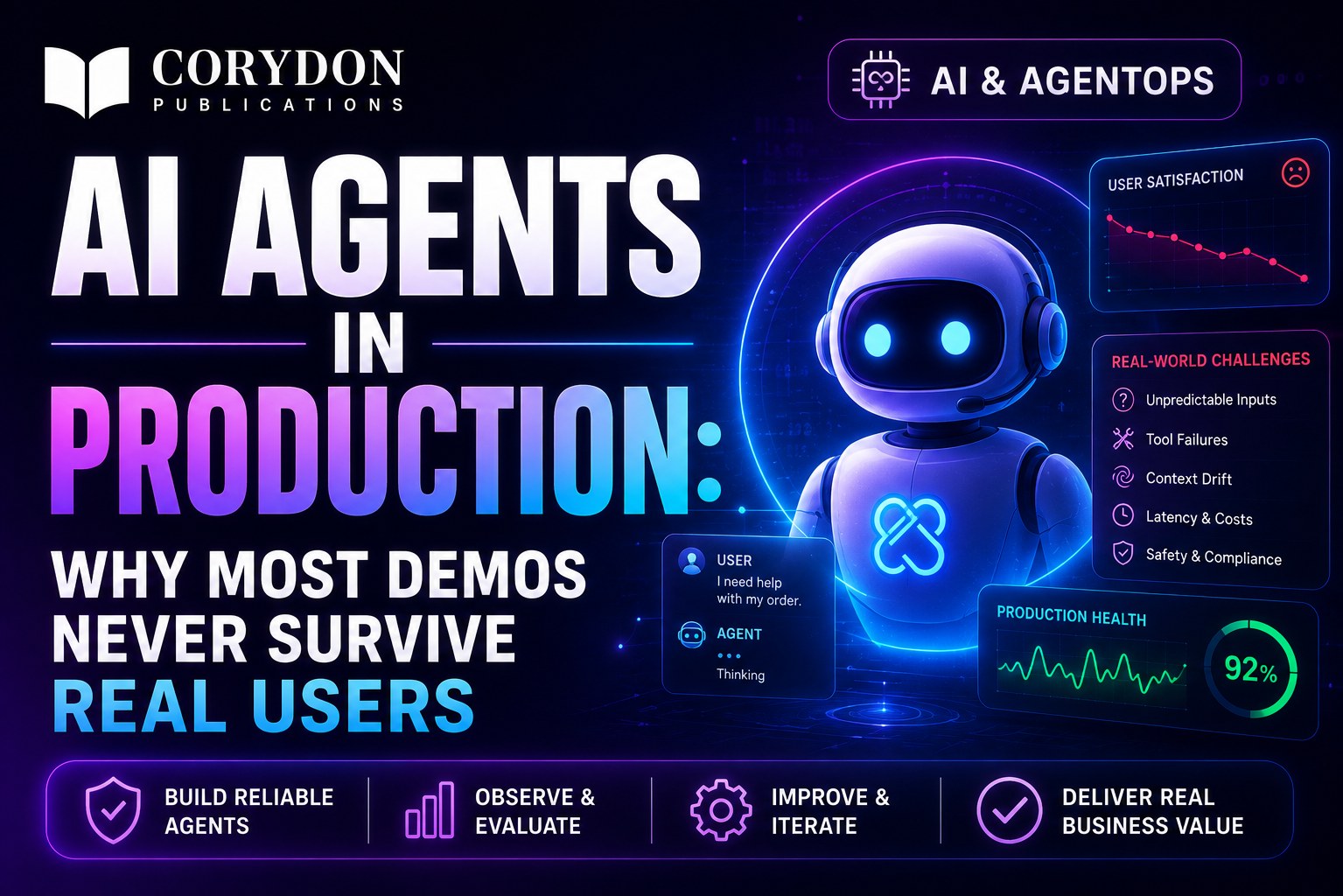
AI Agents in Production: Why Most Demos Never Survive Real Users
An agent that dazzles in a demo and collapses in production is not an anomaly — it is the default. Here is the gap between the two, and the engineering that closes it.

In this article
The demo is intoxicating. You give an AI agent a goal, it reasons, it calls a few tools, and it produces something that looks like magic. Everyone in the room nods. Six weeks later the same agent is in front of real users, and it is confidently booking the wrong meeting, looping forever on an edge case, or spending forty dollars of tokens to answer a question a database lookup would have solved for free.
This is not bad luck. The demo and the production system are different animals, and the distance between them is where nearly all the real engineering lives. Understanding that gap is the difference between a party trick and a product.
The demo-to-production gap
A demo is a controlled environment with a friendly input, a forgiving audience, and no consequences. Production is the opposite on every axis: inputs are hostile or malformed, users do unexpected things, every action has a cost and a side effect, and a wrong answer damages trust or money. The agent that worked in the demo did not get worse — the world got harder.
The core problem is that a language model is non-deterministic. Ask it the same thing twice and you may get two different plans. In a demo you run it until it works and then stop. In production it runs thousands of times a day across inputs you never imagined, and the rare failure mode that appears one time in five hundred is now happening dozens of times daily in front of customers.
An agent that succeeds 95% of the time sounds excellent and is often unusable. If each task chains five model calls, and each call is 95% reliable, the end-to-end success rate is roughly 77%. Reliability compounds downward, and users remember the failures.
The four ways agents fail live
After enough production incidents, the failures sort into four recognisable families.
Tool-call errors happen when the model calls a function with the wrong arguments, or a tool the situation did not call for. Runaway loops occur when the agent cannot decide it is finished and keeps reasoning, burning tokens and time. Hallucinated actions are the frightening ones — the agent invents a step, references data that does not exist, or claims it did something it did not. And cost and latency blowups are the quiet killer: an agent that technically works but takes thirty seconds and costs a dollar per request will never survive contact with a finance review.

Guardrails, retries and fallbacks
The engineering that closes the gap is unglamorous and it is mostly defensive. You wrap the model in a system that assumes it will misbehave and constrains what happens when it does.
A tool call, wrapped for productiondef run_tool(name, args, budget):
    if name not in ALLOWED_TOOLS:        # guardrail: no invented tools
        return refuse(name)
    if not validate(args, SCHEMA[name]):     # guardrail: check arguments
        return retry_with_feedback(args)

    for attempt in range(3):               # retry transient failures
        try:
            return TOOLS[name](**args)
        except Transient:
            backoff(attempt)
    return fallback(name)                 # deterministic safety net
Three ideas do most of the work. An allowlist means the agent can only call tools you approved, so a hallucinated function name fails safely instead of doing something unexpected. Argument validation against a schema catches malformed calls before they execute. And a hard iteration limit — a maximum number of steps — is the single most important line of code for stopping runaway loops. An agent that cannot loop forever cannot bankrupt you overnight.
You cannot fix what you cannot see
The reason demos fail silently in production is that nobody is watching the right things. A traditional web service logs requests and errors; an agent needs to log its reasoning — every step, every tool call, every token spent, every decision to continue or stop. Without that trace, an agent that misbehaves is a black box, and you are reduced to guessing.
Instrument four things from day one: the full step-by-step trace of each run, the token cost per task, the end-to-end latency, and a success signal you can actually measure. When an agent goes wrong at 3am, the trace is the difference between a five-minute fix and a week of speculation. This discipline — treating agent behaviour as something to be observed and measured, not admired — is the heart of what people now call AgentOps.
The loop that actually ships
Teams that get agents into production do not write better prompts than everyone else. They wrap an unreliable component in a reliable system: constrain the tools, validate the arguments, cap the iterations, budget the cost, instrument everything, and fall back to something deterministic when the model fails. The intelligence comes from the model; the reliability comes from the engineering around it.
The demo makes you believe the model is the product. Production teaches you that the system around the model is the product. That shift — from prompt-crafting to systems-building — is the whole discipline, and it is why an agent that survives real users looks so different from the one that dazzled the room.
Evaluation is not optional
The reason teams are blindsided by production failures is that they never built a way to measure success before shipping. A demo is evaluated by vibes — it looked impressive. A production agent needs an evaluation set: a collection of real tasks with known good outcomes that you run the agent against on every change. Without it, you cannot tell whether a prompt tweak that fixed one case quietly broke ten others, and with a non-deterministic model that regression is invisible until users find it.
Good evaluation for agents is harder than for a classifier, because there are many valid ways to complete a task. The trick is to measure outcomes, not paths: did the agent book the correct meeting, retrieve the right record, produce a valid result? Score those on a fixed set of cases, track the score over time, and treat a drop as a release blocker. The teams that ship reliable agents are, without exception, the teams that measure them — and the ones that skip evaluation are the ones whose demos die in front of users.
Start narrow, earn autonomy
The final lesson is about scope. The demos that fail hardest are the ones that gave the agent sweeping autonomy from day one — "here are twenty tools, achieve this open-ended goal". The agents that survive start deliberately small: one narrow task, two or three tools, a human confirming any consequential action. As the system proves itself on the narrow task, you widen the scope and remove the training wheels one at a time, watching the metrics at each step. Autonomy is earned through demonstrated reliability, not granted at launch. An agent that reliably does one valuable thing beats an agent that unreliably attempts ten, every time — in production, in customer trust, and in the finance review that ultimately decides whether your AI feature lives.

Python data work on one printable page — $9.99
The idioms you reach for every day, in one place instead of ten browser tabs. Printable PDF, $9.99, free updates for life.
Grab it for $9.99