
Why Your Metasploit Habit Will Cost You Marks on PT0-003
Automated frameworks make you fast and make you lazy. The exam tests whether you understand what the tool does for you — and that is exactly the understanding a one-click habit erodes.


In this article
Metasploit is a superb framework. It is also, for the exam candidate, a quiet trap. The more fluent you become at "search, use, set, exploit", the less you tend to understand about what those four commands are actually doing on your behalf — and PT0-003 is built to test exactly the understanding a one-click workflow lets you skip.
This is not an argument against tools. Professionals use frameworks every day, and refusing to would be absurd. It is an argument about what you need to know underneath the tool, because the exam — and the harder moments of real engagements — ask you to reason at the layer the framework normally hides.
When a tool becomes a crutch
There is a difference between using a tool and depending on it. A professional who understands a technique uses Metasploit to do it faster. A candidate who only knows the Metasploit workflow can perform the technique when the tool offers a module for it and is helpless when it does not. The tool has become a crutch: it is not extending their capability, it is standing in for capability they never built.
Ask yourself: if the module failed, could you perform the attack by hand? If the answer is "I'd search for another module", the tool is a crutch. If the answer is "I'd do it manually with these steps", you understand the technique and the tool is just saving you time.
What the exam actually tests
PT0-003 does not ask "which Metasploit module exploits this". It asks whether you understand the vulnerability, the technique, and the reasoning — things that live below the framework. A performance-based question may drop you at a plain command line with no framework, expecting you to enumerate, reason, and act using fundamental tools and knowledge.
This is deliberate. A certification that only tested tool operation would certify button-pushers, and the industry does not need more button-pushers — it needs testers who understand what they are doing well enough to adapt when the convenient path is closed. So the exam tests the layer the tool abstracts away, and candidates whose entire practice was framework-driven find themselves unable to answer questions about the mechanics they never had to learn.
Understand the layer beneath the tool
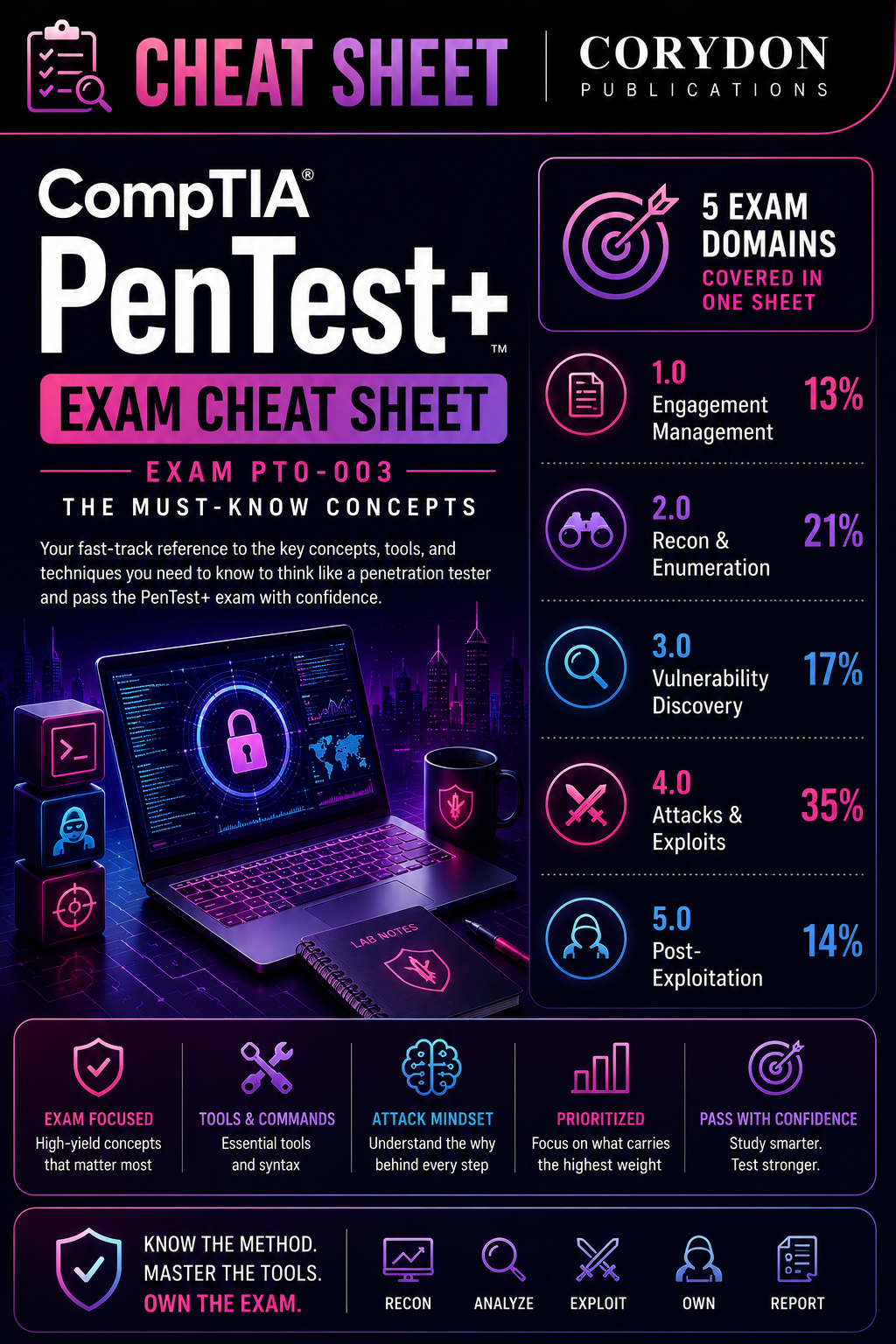
The fix is not to abandon Metasploit — it is to make sure that for every technique you can run through the framework, you also understand what is happening underneath. When a module exploits a service, know what the vulnerability is, why it works, and what the payload does. When the framework hands you a shell, understand what a shell is, how it connects back, and what a defender would see.
Two ways to know the same attack# The crutch: works only if a module exists
msf> search cve-2026-xxxx
msf> use exploit/...
msf> set RHOSTS 10.0.0.5; run

# The understanding: what is actually happening
# - what service, what flaw, what input triggers it
# - what the payload does once it lands
# - how the shell connects back, and on what port
# Know this, and the module is a shortcut, not a lifeline.
A good study habit is to do a technique manually first, understand it fully, and only then let the framework automate it. The manual version teaches you the mechanics; the framework saves you time once you already know them. Do it in that order and the tool amplifies real understanding rather than substituting for absent understanding.
Use the tool, keep the knowledge
In the real world, of course you use the framework — speed matters, and reinventing every attack by hand is a waste of a client's money. But the professionals whose careers last are the ones who can drop below the tool when they need to: when the module fails, when the environment is unusual, when a defender has closed the easy path, or when they need to explain to a client exactly what happened and why. That flexibility comes only from understanding the layer the tool hides.
So treat the exam's bias against tool-dependence as the gift it is. It is pushing you to learn the thing that makes you genuinely capable rather than merely fast. Build the understanding first, let the tools accelerate it second, and you will pass PT0-003 and be a better tester for it — one who reaches for Metasploit as a convenience, not a crutch.
The habit that survives your whole career
There is a longer game here than passing one exam. Tools change constantly — the framework everyone uses today will be superseded, modules rot, techniques get patched and replaced. What does not change is the underlying understanding: how a service can be made to run code it should not, what a shell is, how authentication can be bypassed, why a given input triggers a given flaw. A tester whose knowledge is tied to specific tools has to relearn their craft every few years as the tools move. A tester who understands the fundamentals simply learns the new tool's interface and carries on, because they already understand what it is doing. That durability is the real reason the exam pushes you below the framework. It is not being pedantic or old-fashioned; it is protecting the one asset in this field that does not go out of date. Invest in the understanding beneath the tools, and every future tool becomes easy. Invest only in the tools, and you will spend your career sprinting to stay in the same place.
What to do the week before the exam
If you have been a heavy framework user, spend the final week deliberately unplugging from it. Take the handful of techniques you rely on Metasploit for and perform each one manually at least once, narrating to yourself what every step accomplishes. Enumerate a target with plain command-line tools instead of an automated module. Catch a reverse shell with a basic listener so you understand the mechanics of the connection. Read the description of a vulnerability class until you could explain it to a colleague without mentioning a single tool. This is not busywork; it is exactly the reasoning the performance-based questions demand, and a week of it converts a fragile, tool-dependent readiness into the durable understanding the exam rewards. You will walk in able to answer the "why" and "how" questions that leave framework-only candidates stranded.
Bundle all three best-sellers and save up to $50
A+ Core 1, A+ Core 2 and PenTest+ in one order — $135 in paperback or $80 for all three ebooks. The cheapest route to both certifications.
See the bundle