
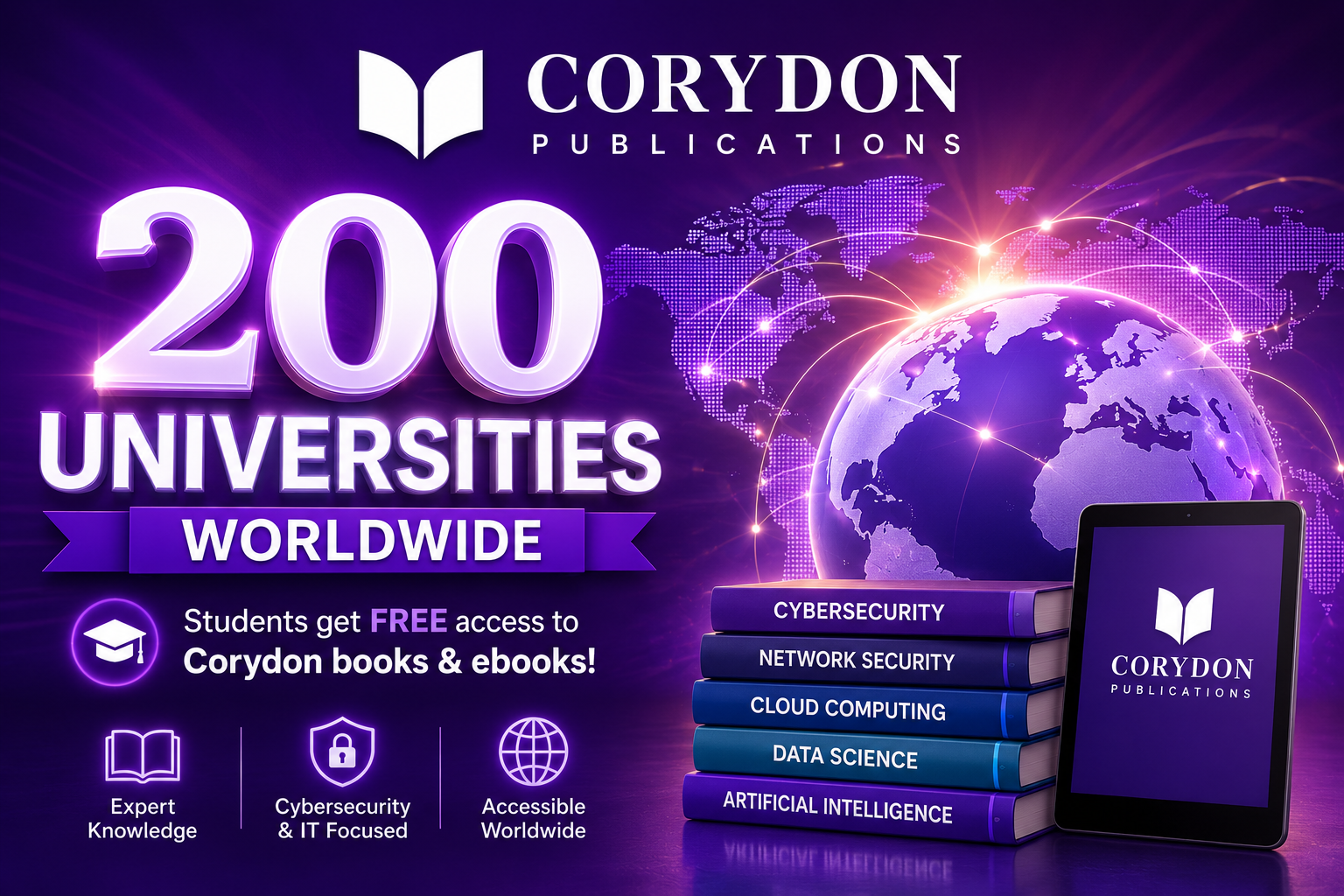
Corydon Publications has reached 200 partner institutions worldwide, spanning universities, technical colleges and vocational training providers that assign Corydon titles on IT, cybersecurity and computing programmes.
Partner institutions receive campus-wide access to the Corydon library through the CertLabz reader, meaning a whole cohort can open the same chapter without a per-seat print order. Instructors get chapter-level progress visibility and can assign labs alongside reading.
What the programme includes
- Campus-wide digital access to the full Corydon catalogue
- Discounted print runs for courses that require physical copies
- Instructor review copies and slide-ready chapter summaries
- Free objective remaps whenever a certification vendor updates an exam
“Corydon books are the only ones I assign without skipping chapters. Practical, current, and well-edited.”
— Dr. Diane Ruiz, Professor of AI
Institutions interested in the programme can reach the education team at [email protected].
Why institutions came looking
Technical curricula age faster than the textbooks written to support them. A cloud module built around a platform’s 2021 console is visibly out of date by the time a cohort reaches it, and an instructor who has to spend the first ten minutes of every session explaining what has changed since the book was printed loses both time and credibility. The demand institutions brought to Corydon was less about price than about currency.
The second recurring problem was access. A department that assigns a title has to decide how many physical copies it can afford, which students get them, and what happens to the rest. Library reservations create queues; queues create students who fall behind for reasons unrelated to ability. Campus-wide digital access removes that rationing entirely.
What partner institutions receive
Partners get campus-wide access to the full Corydon catalogue through the CertLabz reader, so an entire cohort can open the same chapter simultaneously without a per-seat print order. Instructors receive review copies, slide-ready chapter summaries, and chapter-level progress visibility that shows where a class is collectively stalling — which is usually more useful than knowing which individuals are behind.
Courses that genuinely need physical books still get them, at discounted run rates. And because certification vendors revise their exams on their own timetable, partner institutions receive free objective remaps whenever an exam changes, so a module built against one blueprint does not silently become a module taught against another.
How the labs fit
For programmes with a practical component, the browser-based labs remove the single largest source of teaching friction. No lab machine has to be imaged, no student needs local administrator rights, and nothing has to be uninstalled at the end of term. An instructor can set an exercise that runs identically on a university desktop, a personal laptop and a borrowed machine in a library.
Joining the programme
The 200 partners span universities, technical colleges and vocational training providers across several regions, teaching IT, cybersecurity and computing at every level from foundation to postgraduate. Institutions interested in the programme can reach the education team at [email protected] for access terms, review copies and pricing.
How the programme started
The first institutional requests were not for a programme at all. They were individual instructors emailing to ask whether they could put a Corydon title on a reading list, and whether there was any way to get more than one copy into a classroom without a purchase order for thirty paperbacks. When the same message arrives often enough from different continents, it stops being a series of favours and starts being a product.
What those instructors described was a recurring gap. Vendor documentation is authoritative but unteachable. Established textbooks are teachable but age badly. What a module needs is material that is both current and structured for a syllabus, and that is a narrow intersection which very few publishers serve deliberately.
What changes for a department
Campus-wide access removes the rationing problem entirely. Every student on a module can open the same chapter at the same time, which means an instructor can assign reading with confidence that the cohort can actually do it. Chapter-level progress visibility then shows where a class is collectively stalling, which tends to be more actionable than knowing which individuals are behind — a chapter that half a cohort abandons is usually a problem with the sequencing of the module, not with the students.
For programmes with a practical component, the browser labs remove the largest source of teaching friction. Nothing has to be imaged, no student needs local administrator rights on a university machine, and an exercise behaves identically on a lab desktop, a personal laptop and a borrowed machine. Instructors get their contact hours back from setup and troubleshooting.
What partners are teaching
The 200 institutions span universities, technical colleges and vocational training providers across several regions, covering IT, cybersecurity and computing from foundation level through postgraduate study. Certification-aligned modules are the most common use, with the CompTIA titles assigned on courses that prepare students to sit the exams alongside their degree or diploma.
Press enquiries
For interviews, review copies or high-resolution assets, contact [email protected].